Friday, April 1, 2011

Tired of beer, time for a big change.


This may come as a bit of a shock for some people, because I haven't really voiced these feelings here before, but I have been grappling with some very odd feelings over the last 6 months or so. I think with this last year of working a lot (sometimes too much) with brewing and going to all these beer events, yadda yadda, that beer is just getting a little...old. There, I said it. It's just like, how many IPA's or imperial stouts or even complex farmhouse ales or sours can you really drink before it all starts to taste the same?

I've been drinking a lot of nice local wines lately, and learning about different varieties, and it's been really refreshing just to taste and learn about something that's not beer for a while! I may get some flack for this, but I have always been one to speak my mind: wine just really is more complex than beer. I realized when we started the Flanders barrel project that I do want to work with barrels, it's just not beer that I want to put in them anymore.

It feels weird. It feels like I am breaking up with a girlfriend of 9 years. Will I even know how to live my life without her? Of course, but it will take a while. It's time to see other people. I'll still see her around at parties from time to time and we will have our awkward conversations, and maybe even be friends some day, but I need some time apart before that can happen.

I have been speaking with a local winemaker, a guy I met during my search for wine barrels, who says he might need some help in the fields this summer. It's a small mom & pop operation in Yamhill. Don't want to give away the name of the winery yet, but I'l fill you in with details when the time is right.

I still wish all you guys the best in your beer brewing adventures. If you're interested in reading a winemaking blog, stay tuned for future posts!
Chin Chin!


Wednesday, March 30, 2011

Golden Lager Tasting

Here's a tasting of the "Golden Lager" I did brewed quite a few months back.
5.2% ABV, 28 IBU's

Aroma: "Beery" Lager aroma, moderate spicy/herbal hop character, slight malt sweetness, pretty big toasted bread/ graham cracker aroma from Munich malt & melanoidins. Very clean lager fermentation with almost no noticeable esters. Clean alcohol, no diacetyl.

Appearance: Very clear, though obviously not filtered, deep golden color, not a huge head but a well-retained white head that leaves a lacing. Fairly spritzy carbonation, just right for a traditional lager.

Flavor: Big malt flavor up front with a moderate caramel flavor, big toasted bready character, and moderate residual sweetness. Bitterness is moderate with a higher than average hop flavor than most German lagers of its type. Finishes malty but a touch of natural acidity helps dry the aftertaste. Bready malts come through again after the swallow. Fermentation character is very clean, no off flavors and you almost don't notice the alcohol at all.

Mouthfeel: Medium-full body with noticeable dextrins give it a creamy texture. Lively bubbles. slight acidity provides more of a thirst-quenching impression
Overall: This beer really fits the bill for a Dortmunder or lighter-colored version of an Oktoberfest. This was a beer that, when younger, definitely had a bit too much finish hop profile going on, that sort of got in the way of the malt complexities. It still does have more than average hop aroma/flavor for a German style lager, but it's much better integrated. The additional lagering time has really helped round this beer out substantially (I use the word "lagering" a bit loosely since it really just sat in a keg at about 38 degrees for a few more months). My main complaint is that the Munich malt comes off as a bit too heavy, or maybe it's coming more from the carahell, but I get a little too much bready flavor in the finish that almost makes it seem earthy or vegetal, if that makes any sense. I would play around with the proportion of specialty malts a bit, perhaps lowering the percentage of both Munich malt and carahell, and adding back a little caramunich for color and residual sweetness. I would also reduce the finishing hops by a half-ounce. I like the yeast, but it also might be fun to play around with a "malty" lager yeast, as opposed to this "clean, dry" version that is admittedly a great workhorse lager strain. If I wanted to perfect this beer though, I would probably start by adjusting the malt and hop bill, and then play with the yeast later once I got that dialed in. Overall it's a very good drinking beer, quaff-able, with the overly bready character being slightly annoying and keeping me from going back for a second pint, but the lager brewing technique is very spot-on and that's what's most important.

Wednesday, March 23, 2011

Wontonamo Bay (batch 2) IPA tasting


Ah, a day off. I don't get enough of these right now, and I'm enjoying it! I haven't left the house or even put on real pants for that matter. I am wearing Clarissa's pajama bottoms because mine are in the wash. But you don't want to know about that...how about a homebrew tasting?


Aroma: Piney, spicy, slightly oily hops, some general citrus/fruit aromatics with a little grapefruit. Fairly dank, with a light caramel malty note, very clean/background malt aroma, no diacetyl, clean fermentation profile with clean alcohol.

Appearance: Very clear, deep copper with moderate carbonation. Wispy white head, but OK retention, would probably persist longer if carbonation were higher. The finings seem to have helped the clarity quite a bit compared to my previous hop-hazed beers (which I really don't mind at all).

Flavor: Full-on hop blast in the first sip, a lot of flavor hops going on here. I get a little onion from the summit, an overall spicy, herbacious and piney flavor, a little grapefruit. Malt is very clean, just a touch of caramel malts let the hops really come forward. Bitterness has calmed a bit since it was first brewed, but it is still has a clean, bitter, slightly woody finish with just a touch of residual sweetness. A little flavor contribution from the Carapils. I swear there is a distinct flavor to beers with Carapils, even though most people would tell you it just adds body. A bit of alcohol at the end, but hey, this is an alcoholic beverage. It's not hot or bitey.

Mouthfeel: Slight slickness or creamyness from some residual sugars, great bubblyness, crisp finish with a little hop astringency.

Overall: I think this beer has really gotten better with a little time, and it's definitely the best IPA I have ever made. But that is compared to a lot of IPA's that just seemed to be too balanced or problematic in other ways. I'm not really sure if I would change anything. I need to drink more of it to find out! It's pairing nicely with my rustic lunch of homemade bread, sharp cheddar and stilton.

In all likelihood, with my current work schedule, I won't be doing any homebrewing for the next month or so. That will be my biggest break since moving out to Oregon. So, until I get some new brews going, I'm going to try to update the blog about once a week with a beer tasting of something that I've already brewed. I hope to get back to homebrewing at least once a month by May, and really just concentrate on brewing 10 gallon batches of lower alcohol, drinkable beers, or doing sours or strong beers that I can brew and forget about for a while.

Wednesday, March 16, 2011

Temperanillo Barrel Flanders Red

PAUL KEY

I've been wanting to get a group of homebrewers together for a barrel project together for years now, and of course the crucial missing piece of the puzzle was having someone who owned a house with a basement to host the barrel. This all changed when my friend Walker Pruett, who brews for Old Market Pub, bought a house in SE Portland with a big, dry, spacious basement. As soon as I saw it I had to ask if he was interested, and he was very excited to take on the project. I see barrel aging sours as one step above the carboy-aged sours that I have been playing with in the past. There's just something about the wood character, and the microporous environment that really seems to make a difference between a very good sour beer and a great one. My carboy sour beers have been pretty good, but seem to lack the acidity of the best commercial sours. I guess the next step beyond aging homebrew in a barrel is aging homebrew in multiple barrels, so you have blending options, and there may be some potential for that in the future, but for now this will be a great start.

The group consists of myself, Walker, Sean Burke (who is currently at Siebel taking their 6 month American/German learning program), Paul Key, Rik Hall, and Ben Parsons. I pitched the idea of a wine barrel-aged Flanders red for 2 reasons: The first was having tried an incredible pinot barrel-aged Flanders red from Mike Tonsmiere, and the second being that we already had 15 gallons of Flanders brewed that would be a source for souring bugs.

THE BARREL: LAST USED FOR 2009 EVESHAM WOOD TEMPERANILLO, MADE WITH GRAPES FROM ILLAHAE VINYARD, ALSO IN OREGON

I sourced the wine barrel from Eveshem Wood Vinyard, on a recommendation from Paul that they made excellent Pinot Noirs. However there was a bit of a miscommunication, and we ended up with a used Temperanillo barrel from them instead of a Pinot barrel. I think this will be great though; I wasn't too set on the wine varietal, I just wanted to use a barrel that had aged Oregon-grown grapes. The barrel smelled great when we got it and had already been emptied and treated with sulfur a few weeks beforehand, so all we did was give it a couple of cold-water rinses before filling. The barrel was in excellent condition with not even a tiny leak that needed patching.

WALKER PRUETT, TESTING OUR STAINLESS STEEL NAIL FOR SAMPLING

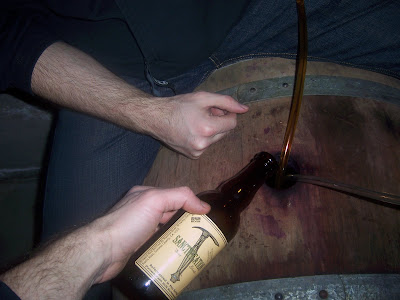
We gathered for filling the barrel at Walker's house on March 4th, the day before my 32nd birthday, and it was a great birthday gift to start a barrel project with such a fun group of talented brewers. We had brewed a total of 60 gallons, which almost topped off the barrel, and we are hoping to brew a "top-off" batch soon to fill the remaining head-space and provide filler for the "angel's share" which will evaporate off through the wood (or be diminished by taste tests!) in the coming months or years. Currently there is about a 4-inch head-space in the barrel which I would like to eliminate sooner than later, to keep any acetic acid producing bacteria from turning this into the world's biggest batch of homebrewed malt vinegar. That would take a lot of pommes frites to soak up!

RIK HALL


A LITTLE FUNK-PELLICLE ALREADY?


OUR "BARREL RACK", EVIDENCE THAT WE ARE NOT GREAT CARPENTERS, WAS MADE OUT OF AN OLD PALLET.


JOLLY PUMPKIN AND CHEEZ-ITS. YEAH, WE'RE THAT CLASSY.

BEN PARSONS

ADDING SOME COMMERCIAL FUNK

Here is what has gone into the barrel so far:
- 5 gallons of month-old "Jamil Zainacheff" Flanders Red, brewed by Sean Burke and fermented with the Roselaire strain from primary
- 10 gallons of a year-old Flanders red that Paul and I brewed using Al B (now East Coast Yeast)'s "Rodenbug" blend. This was tasting very good at one year, but my batch had definitely soured more than Paul's, I think because my batch was aged at room temp while his was aged at basement temp.
- 45 gallons of new Flanders wort based on the Wild Ales recipe, average O.G. /F.G. of 1.064/ 1.022, 12-15 IBU's, fermented with clean ale yeasts
- Dregs from 2 750 ml bottles of Jolly Pumpkin ales, 1 375 ml bottle of Russian River Supplication, 1 375 ml bottle of Russian River Sanctification (more dregs to follow, almost definitely including Cantillon / Drie Fonteinen).

The plan is to get together every 3 months or so to taste what's going on in the barrel. When we rack out, we will probably just let people collect their portion in carboys or kegs to do as they please, either adding fruit, or blending it with other batches, or serving it straight-up. We have also talked about turning this into a single-barrel "solera" project, racking out only half the beer when it's ready and adding something new. Who knows, maybe we will add one more barrel to Walker's basement too. In any case, I hope the beer turns out great (I think it will at least turn out very good), and it will be a great learning experience no matter what. I can't wait to see how it develops in the coming year!

Wednesday, February 16, 2011

Rest In Peace - Chick Chick Chick: 2009-2011

Our little kitty passed away on Valentine's day, and we are really very sad. She was hit by a car and it looks like she went instantly, so at least she didn't suffer too much. We had to bury the poor little thing in the yard, and we only had her for one year. I wish we had had a way to keep her out of that busy street, but I don't think cats should be held hostage indoors. She was such a friendly, playful outdoor cat, hanging out in the neighbors' yards and even sneaking in their houses sometimes. She would hang out with me in the garage while I was brewing and beg to be petted or played with, which was annoying because I didn't want to get a bunch of cat hair in the sanitizer. My point is that we knew the busy road was a risk, but I believe cats should be allowed outdoors. It's just part of their nature to play outside and have adventures. So I guess we need to figure out some kind of invisible fence for the next cat if we decide to have one here, or we could just wait until we live somewhere farther off from a busy street. Damn, life sucks sometimes. I will miss her so much, she was really a great cat and she gave us a lot of joy. The house feels lonely today without her around.


Anyway, I haven't posted any brewing stuff here lately because I've been really busy, in a good way. I have brewed 2 beers: a Belgian Dubbel that I'm planning on splitting some off of and doing some experimentation with (adding quince), and I also brewed a 10 gallon batch of Flanders red that is destined for a wine barrel. I have been wanting to do a barrel-aged sour ale for a while now, and my friend Walker offered up his basement to host the project. We have 6 brewers who are in on the project, the beers are brewed, and now we need to pick up a barrel. So I'll post these recipes later when the dubbel is on tap and when the barrel is full.

Other than that, the reason I really haven't posted is I've been working 6 days a week. I'm still brewing at Alameda 4 days, and I also picked up a couple days at Cascade Brewing, which so far has been a lot of keg washing and filling, but it should be a lot of fun as we get to the more interesting things like working with barrels and all the other fun beers that they do.

So, with this much work I think I'll be slowing down on homebrewing a bit, maybe brewing once a month or something like that. I'll try to keep this blog updated, but if I really end up working my butt off, it might become fairly sporadic. Time will tell... I have decided I really want to keep this blog mainly about homebrewing and leave the pro brewing stuff at work mostly.

Anyway, happy brewing to you all. I'll try to catch up on a few tastings soon. I have the rauchbier that is tasting really nice and I need to go back and do a tasting of the gold lager, and the recently kegged IPA. Catch ya soon.

Sunday, December 26, 2010

Christmas Staycation IPA


What do you do when you have the week off from work and not enough dough to fly home for the holidays? Brew! That's not all I've been up to, I've also been finding time to socialize, get out on some nice hikes, and clean up around the house. But on Christmas morning, it was all about throwing on some good tunes and brewing. After coffee of course.

This recipe is really the batch two of the "Wonton-amo Bay IPA" that I did in July. The first batch was one of the only beers I have ever made that had a diacetyl problem, and sadly I didn't recognize it in time to fix it. So this time around, I aim to make damn sure it's fully fermented before I crash it, but other than that it's fairly identical. Exact same malt bill, although it's lower O.G. due to slightly less efficiency an intentionally bigger final volume (I was aiming for 1.062ish so I was only a bit below target). Slightly higher mash temp. Very similar hop schedule, but some minor adjustments were made based on what I had in the freezer. I'm adding some Chinook and Citra to the dry hops in addition to what was added last time. Should be an all-out hop bomb, but also very clean, dry and drinkable. I've got high hopes that this one will redeem me from my last flawed attempt at IPA greatness.

Wonton-amo Bay IPA - Batch 2
Brewed on 12/25/10
Recipe is for 7 gallons pre-boil, 5.9 gallons post-boil, all grain
O.G. 1.060 F.G. 1.014 ABV 6.1% IBU's 87

10.5 lb. 2-row pale malt (Great Western Organic)
1 lb. wheat malt
.5 lb. Crystal 60
.5 lb. Carapils

19 gr. Warrior pellet 15.8%AA 60 min
20 gr. Summit whole 18%AA 30 min
36 gr. Amarillo whole 8.7%AA 10 min
14 gr. Citra whole 11%AA 10 min
6 gr. Chinook whole 14.2% 10 min
28 gr. Simcoe pellet 12.2% 0 min
28 gr. Centennial whole 7.8% 0 min
14 gr. Simcoe pellets dry hopped in the primary
14 gr. each: Centennial, Chinook, Citra, Simcoe, Amarillo, whole hops, dry hopped in the keg in a "sock".

Mash: 4.5 gallons water plus 3 tsp. Burton Salts
Mash in to 153 for 60 minutes, fell to 150.
Sparge with 5 gallons at 170
Collect 7 gallons at 1.050 = 79% efficiency
Boil 60 minutes, with hop additions as noted.
Added 1 tsp. Burton salts to kettle.
Wyeast nutrient and whirlfloc at 10 minutes.
Whirlpool, rest 10 minutes while setting up plate chiller.
Chill/transfer thru plate chiller over 10 minutes
Collect 5.5 gallons at 68 degrees.
Oxygen 60 seconds
Pitched 2 packages Wyeast 1056 Cali Ale Yeast
Ferment at 69
1/6/10 Primary dry hops added
1/18/10 Kegged, 1.014. Tastes and smells so freakin' good, not sure if it needs any extra hops but they were already in the keg. 2nd dry hop.

Thursday, December 23, 2010

American Session Stout - for lack of a better name

Wyeast West Yorkshire ale yeast. It's a new seasonal strain that I think was put out this year or last year for the first time. Jamil Zainacheff has said he really likes the way it works and the flavors produced by it. And I got a pack for free a few months ago from Owen at Wyeast (thanks again). It's still available through the end of December if you are interested in brewing with it. Here's some data from their website:

Wyeast 1469 PC West Yorkshire Ale
This strain produces ales with a full chewy malt flavor and character, but finishes dry, producing famously balanced beers. Expect moderate nutty and stone-fruit esters. Best used for the production of cask-conditioned bitters, ESB and mild ales. Reliably flocculent, producing bright beer without filtration.Attenuation 67-71%
Alc. Tolerance 9%
Flocculation highTemperature Range 64-72°F (18-22°C)

I used it for the first time in the Dark Mild I brewed with the second runnings from our Baltic Porter. It's a solid little beer. I would like to have some more malty sweetness, but that is more recipe based than anything. It's good to drink. The esters are clean, the yeast flocced out hard and cleaned up the beer nicely, both in flavor and clarity.

The yeast is said to have been sourced from Timothy Taylor brewery in West Yorkshire. I haven't tried their beers, but apparently they make some fantastic full-flavored bitters and dark milds. Not one of the beers listed on their website comes in at over 4.3% ABV, so to see beer geeks go gaga over their beers is saying something special. And according to their reviews on Beeradvocate, they are making some phenomenal beers. Not that all this can be attributed to the yeast, in fact I'd argue that's mostly to the brewers' credit.

Judging from the flavor of the dark mild, I would say the West Yorkshire strain is similar to the Wyeast London Ale III in performance and flavor, which supposedly comes from Bodddington's. I have used that in a previous mild, and it's a strain that one of the local breweries uses to make some fantastic hoppy beers. So its uses shouldn't be limited to English style ales, although that is probably what it is best at.

Thinking along the lines of session beer, and something full-flavored enough to stand up to the cold rainy weather we have been dealing with here, I decided to come up with another recipe using the West Yorkshire yeast. I wanted to keep it cheap by using only ingredients I already had. A session stout perhaps, based on the historical stout grists that you can read about on Ron Pattinson's "Shut Up About Barclay Perkins" blog. That sounded good. Maybe some woody, piney hops though. But not over-the-top hoppy. I tried to exercise constraint here with all the ingredients, to find a balance of flavors that would be complex yet drinkable. The brown malt should add some toasted bread dryness, as this malt tastes exactly like almost burnt artisan bread crusts. Some roast / coffee / espresso flavors, but not as much as Guinness or a really roasty stout. I left out the crystal, which is a leap of faith, but I want it to be a stout, not a porter.

I am really excited about this beer, but I don't really have an idea of what the final balance of flavors will be. It could be more hoppy or more stouty, or more portery. It's tempting to give it some sarcastic name like "Cascadian dark pale ale" or what have you. But it's not supposed to be Cascadian. It's supposed to be a session historical stout with an American hop twist. I'm fairly certain it will be darn tasty, but only time will tell how if the flavor comes close to my original intention.

Dilation Stout*
Brewed on 12/20/10
Recipe is for 7 gallons pre-boil, 5.7 gallons post-boil, all grain
O.G. 1.050 F.G. ABV IBU's 41

6.5 lb. Great Western Organic Pale
1 lb. Munton's Marris Otter
1 lb. Flaked Barley
14 oz. British roasted barley 600L
8 oz. Belgian aromatic malt 25 L
8 oz. British brown malt 70L

21 gr. Chinook whole 14.1% AA 60 min
14 gr. Chinook whole 14.1% AA 0 min
30 gr. Cascade whole 7 % AA 0 min

Mash, 153 for 50 minutes, fell to 149
Sparge with 5 gallons at 170
the only water adjustment was chlorine removal with campden

Collect 7 gallons at 1.041 = 79% efficiency
Boil 90 minutes
Whirlfloc & yeast nutrient at 10 min
Whirlpool/rest 10 minutes after flame off
Chill thru plate chiller over 10 minutes to 60
Oxygen 1 minute
Pitch West Yorkshire 2nd generation
Ferment at 68-69 degrees
1/6/11 Racked to keg, tastes phenomenal but couldn't believe it was still at 1.024!!! WTF, that yeast dropped out super early. I'm going to take another taste, gravity, and decide whether to krausen with more yeast. I need some zwickels on my carboys to take regular gravity samples!

* I brewed this beer right after coming back from the optometrist for my yearly perscription check. The doctor dilated my pupils, to the point where I could hardly see! Check out the picture below. For the most part I had to work without my glasses and squint to see anything. Also if I went to far away from a piece of equipment I had to walk around squinting to find it again. The garden hose, which is white, looked like a glowing electric ghost-line against the ground. Despite visuals worse than any I have ever experienced with drug "experimentation" in my youth, I felt no fun side effects. Gradually the eye dilation drops wore off over 6 hours or so and I could see again. The fur hat I'm wearing in the photo was because it was a really cold day for brewing.

On Deck: Christmas Stay-cation IPA