Showing posts with label Group Project. Show all posts

Monday, February 27, 2012

Group Brewday: Golden sour project

The Temperanillo barrel aged Flanders Red has been in the barrel for almost exactly a year now, and it's tasting great. The acidity is moderate, with a little acetic character. But the complexity from the Brettanomyces, and the wood and wine character from the barrel is amazing. It sucks to say, this barrel aged beer is putting any of my previous carboy-soured homebrews to shame. That in itself s a big lesson in how important a barrel is to brewing quality sour beers. I'm not saying "Don't brew sours if you don't have a barrel," (some people have had a lot better results with the carboy sours than I have) but I believe it makes a real difference. In some ways this beer feels like it brewed itself, and that we had very little to do with its success.

In any case, since I am going to be moving away soon, I have to give up my slot in the group project for the next beer to go into the Temperanillo barrel. My slot will be taken over by Mike Wright, the owner of The Commons Brewery (formerly Beetje nano-brewery). The barrel project will still be strictly homebrew, but we did have the advantage of brewing all the wort at The Commons in one day, with a double-batch on the 35+ gallon "Beetje" system (the original nano-brew system from before" Beetje" expanded to a 7-barrel brewery and became "The Commons".

The group decided to do a golden sour this time. After some deliberation on the recipe, we stuck to a pretty simple design:

1.062 O.G
85% Gabrinus Organic Pilsner malt
8 %Vienna malt
6% CaraHell
1% Acidulated malt
Mash at 154
Boil 90 minutes
10-12 IBU's from Perle hops at 60 minutes.


As the above picture clearly illustrates, we brewed the beer on a Sunday morning, and many of us had had a late Saturday night. Luckily we had donuts from Acme Donuts, and not much work to do for a lot of the time. Some drinking was done and it was decided that we all really like Green Flash "Rayon Vert", as well as The Commons "Flemish Kiss", both dry hopped, brett-aged belgian pale ales inspired by Orval.

The brewday was very straightforward, but it did end up being about 12 hours, and we still had to get 16 carboys over to Walker's house by car.

Since the only big space we had to ferment the beer in was Walker's basement, we decided to use an alt yeast to ferment the beer. Wyeast #1007 / German Ale Yeast is one of The Commons house yeasts, and we fermented it at ambient basement temperature, which ended up being about 63 degrees fermentation temp.

We are scheduled to rack the beer into the barrel on the same day we rack the Flanders out. We are going to do as little barrel cleaning as possible, possibly just giving it a quick cold water rinse to get most of the trub out. Possibly not even that. We also discussed the idea that if for some reason the golden sour does not progress enough in actual sourness, because of the clean primary fermentation, we could top-up with a strong lacto culture, possibly isolated from a bottle of Fantome or Cascade beer.


As it turns out, we are racking the Flanders out on March 4th, exactly one year after it was filled. That wasn't planned, I just realized it today when looking back at the notes for the first barrel fill. I won't be in town, as Clarissa and I will be in San Clemente for the birth of her sister's first baby. Sounds like a visit to Pizza Port is also in order!

I still haven't gotten around to putting up a post on our other barrel project, the Old Ale with Brett C. that I jokingly call the Billy The Mountain Clone (it was first intended for a 2nd-used bourbon barrel, but we ended up using a pinot barrel due to availability, just like Upright's Billy). I guess I'll get to this when we pull a sample from that barrel, which should happen some time in March.


Wednesday, March 16, 2011

Temperanillo Barrel Flanders Red

PAUL KEY

I've been wanting to get a group of homebrewers together for a barrel project together for years now, and of course the crucial missing piece of the puzzle was having someone who owned a house with a basement to host the barrel. This all changed when my friend Walker Pruett, who brews for Old Market Pub, bought a house in SE Portland with a big, dry, spacious basement. As soon as I saw it I had to ask if he was interested, and he was very excited to take on the project. I see barrel aging sours as one step above the carboy-aged sours that I have been playing with in the past. There's just something about the wood character, and the microporous environment that really seems to make a difference between a very good sour beer and a great one. My carboy sour beers have been pretty good, but seem to lack the acidity of the best commercial sours. I guess the next step beyond aging homebrew in a barrel is aging homebrew in multiple barrels, so you have blending options, and there may be some potential for that in the future, but for now this will be a great start.

The group consists of myself, Walker, Sean Burke (who is currently at Siebel taking their 6 month American/German learning program), Paul Key, Rik Hall, and Ben Parsons. I pitched the idea of a wine barrel-aged Flanders red for 2 reasons: The first was having tried an incredible pinot barrel-aged Flanders red from Mike Tonsmiere, and the second being that we already had 15 gallons of Flanders brewed that would be a source for souring bugs.

THE BARREL: LAST USED FOR 2009 EVESHAM WOOD TEMPERANILLO, MADE WITH GRAPES FROM ILLAHAE VINYARD, ALSO IN OREGON

I sourced the wine barrel from Eveshem Wood Vinyard, on a recommendation from Paul that they made excellent Pinot Noirs. However there was a bit of a miscommunication, and we ended up with a used Temperanillo barrel from them instead of a Pinot barrel. I think this will be great though; I wasn't too set on the wine varietal, I just wanted to use a barrel that had aged Oregon-grown grapes. The barrel smelled great when we got it and had already been emptied and treated with sulfur a few weeks beforehand, so all we did was give it a couple of cold-water rinses before filling. The barrel was in excellent condition with not even a tiny leak that needed patching.

WALKER PRUETT, TESTING OUR STAINLESS STEEL NAIL FOR SAMPLING

We gathered for filling the barrel at Walker's house on March 4th, the day before my 32nd birthday, and it was a great birthday gift to start a barrel project with such a fun group of talented brewers. We had brewed a total of 60 gallons, which almost topped off the barrel, and we are hoping to brew a "top-off" batch soon to fill the remaining head-space and provide filler for the "angel's share" which will evaporate off through the wood (or be diminished by taste tests!) in the coming months or years. Currently there is about a 4-inch head-space in the barrel which I would like to eliminate sooner than later, to keep any acetic acid producing bacteria from turning this into the world's biggest batch of homebrewed malt vinegar. That would take a lot of pommes frites to soak up!

RIK HALL


A LITTLE FUNK-PELLICLE ALREADY?


OUR "BARREL RACK", EVIDENCE THAT WE ARE NOT GREAT CARPENTERS, WAS MADE OUT OF AN OLD PALLET.


JOLLY PUMPKIN AND CHEEZ-ITS. YEAH, WE'RE THAT CLASSY.

BEN PARSONS

ADDING SOME COMMERCIAL FUNK

Here is what has gone into the barrel so far:
- 5 gallons of month-old "Jamil Zainacheff" Flanders Red, brewed by Sean Burke and fermented with the Roselaire strain from primary
- 10 gallons of a year-old Flanders red that Paul and I brewed using Al B (now East Coast Yeast)'s "Rodenbug" blend. This was tasting very good at one year, but my batch had definitely soured more than Paul's, I think because my batch was aged at room temp while his was aged at basement temp.
- 45 gallons of new Flanders wort based on the Wild Ales recipe, average O.G. /F.G. of 1.064/ 1.022, 12-15 IBU's, fermented with clean ale yeasts
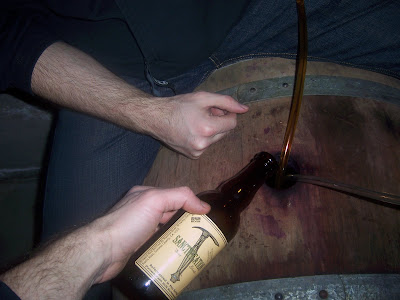
- Dregs from 2 750 ml bottles of Jolly Pumpkin ales, 1 375 ml bottle of Russian River Supplication, 1 375 ml bottle of Russian River Sanctification (more dregs to follow, almost definitely including Cantillon / Drie Fonteinen).

The plan is to get together every 3 months or so to taste what's going on in the barrel. When we rack out, we will probably just let people collect their portion in carboys or kegs to do as they please, either adding fruit, or blending it with other batches, or serving it straight-up. We have also talked about turning this into a single-barrel "solera" project, racking out only half the beer when it's ready and adding something new. Who knows, maybe we will add one more barrel to Walker's basement too. In any case, I hope the beer turns out great (I think it will at least turn out very good), and it will be a great learning experience no matter what. I can't wait to see how it develops in the coming year!